
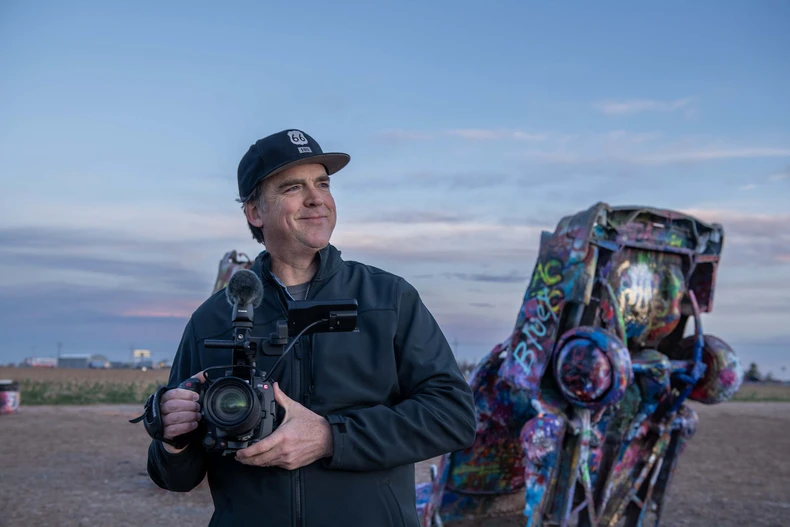
For more than three decades, filmmaker John Paget has followed the Mother Road. As Route 66 celebrates its Centennial, Paget returns with a new documentary about the people, places and stories that make the historic highway more than just a road.
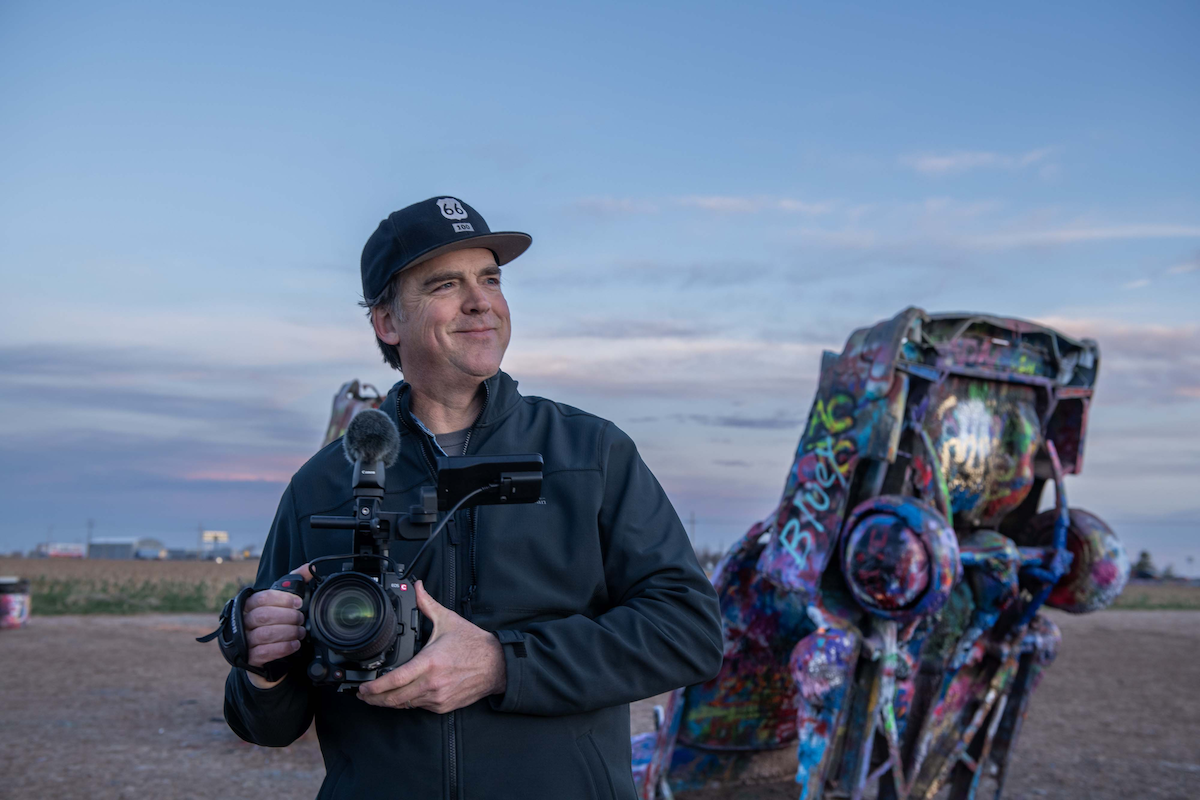
Route 66 has never been just a road.
For 100 years, the Mother Road has connected cities, small towns, roadside attractions, diners, motels and the people who gave each stretch of pavement its own character. In 2026, Route 66 celebrates its Centennial — and filmmaker John Paget is marking the occasion by returning to a road he has spent more than three decades documenting.
His new documentary, Route 66: The Main Street of America, follows Paget through all eight Route 66 states, meeting the people who preserve the road's history, sustain its traditions and continue to shape what Route 66 means today.
Watch the Trailer
For his latest production, Paget spent a full year on the road — scouting, filming and retracing his path. Along the way, he encountered everything from unexpected food and roadside characters to deeply personal stories of migration, community and reinvention.
We caught up with Paget to talk about the people, places and unexpected discoveries that made their way into the film — and why, after all these years, Route 66 still has more stories to tell.
Q&A With John Paget
You've driven Route 66 dozens of times over the past 33 years. How was this latest journey different?
I've made dozens of journeys on Route 66, going back 33 years. During the 1990s, I made two Route 66 documentaries, so I was often driving the road to shoot the films, then heading back out again to promote them.
For this latest production, we spent a full year on the road in total — scouting, filming and retracing our path. It was a combination of a few end-to-end journeys and a lot of back-and-forth across certain sections.
The odometer rolls on, but I'm not counting the miles. Route 66 never gets old. It never fails to surprise me.
What were some of your favorite unexpected stops along Route 66?
One of the country's largest Asian-American districts sits right on old Route 66, along Classen Boulevard in Oklahoma City. Food has always been part of the Route 66 experience, and to me this is part of how that tradition continues to evolve. After a thousand miles of cheeseburgers and chicken-fried steaks, suddenly you're eating bánh mì sandwiches, bubble tea and steaming baskets of dim sum — food that is authentic, adventurous and rooted in the communities that now call the Mother Road home.
Harley Russell at the Sandhills Curiosity Shop in Erick, Oklahoma, completely blindsided us. We walked through the door not knowing quite what to expect, and within minutes were exchanging looks that said, "What have we gotten ourselves into?". Harley was hilarious, outrageous, unpredictable and completely uninhibited. We started up the cameras and kept them rolling. I wouldn't say we interviewed him — it was more like hanging on for the ride.
Brenda Hammett at the Midpoint Cafe in Adrian, Texas, was almost the opposite. She was nervous about being interviewed, but once she started talking, there was no performance at all — just this extraordinary sincerity and vulnerability. She wears her heart on her sleeve, and her story became one of those unexpected moments of magic in the film. If that weren't enough, she sent us back onto the road with a stack of her handmade pies.
What's the most underrated stretch or stop on Route 66, and why?
There are a few, but one is the original western terminus of Route 66 in downtown Los Angeles, at 7th and Broadway.
It's underrated probably because it's often skipped. Most travelers head straight for Santa Monica and the ocean. But this mile of 66 is home to the largest concentration of historic movie palaces in the world. It's a place where the movie industry as we know it was born.
Today, towering neon signs and grand theaters still bear witness to that history. It's one of the most extraordinary urban stretches of the entire road. And to top it off, there's a great story behind how those historic theaters were saved from demolition — which became part of the film.
How did you plan your Route 66 journey? Did you map out your stops in advance or leave room for spontaneity?
It was a combination.
We had to schedule some people and locations in advance. But rather than book those interviews back-to-back, we deliberately built flex time into the schedule for exploration and discovery.
That breathing room was important. Some of the best things you find on Route 66 are the things you weren't looking for.
What story or person you encountered while making the documentary surprised you or stayed with you the most?
One of the most powerful stories we encountered was that of Ba Luong in Oklahoma City.
Ba was still a toddler when his family fled Vietnam in a fishing boat, eventually reaching a refugee camp in Malaysia and then the United States. Like many other refugees, they settled along Classen Boulevard in Oklahoma City — right on Route 66. His parents ended up running a small Vietnamese market called Cao Nguyen.
Over the years, that little market grew into Super Cao Nguyen, an extraordinary international supermarket in the heart of Oklahoma City's Asian District right off Classen. I call it the most amazing grocery store between Chicago and Los Angeles. It's 50,000 square feet, with items from over 60 countries.
This whole story unfolded right on the Mother Road. What really struck me is how powerfully it echoes The Grapes of Wrath — another story of refugees in flight searching for a promised land. Only this time, Oklahoma isn't the place people are fleeing. Oklahoma is the promised land.
Route 66 has so many iconic attractions. Is there one classic stop you think every first-time traveler should make?
There really isn't one classic stop.
Route 66 is like a quilt — or a great dish. Its true essence only emerges when you take it in as a whole.
It's Tucumcari's neon blue birds and the serpentine drive through Sitgreaves Pass; it's Arcadia's Round Barn and Catoosa's Blue Whale. It's Amarillo's 72 oz Steak and El Reno's fried onion burgers. It's how all of those things accumulate mile after mile until they become something larger.
If someone is planning their first Route 66 road trip, what's one piece of advice you'd give them?
Go slow. Look for old things and odd things.
When you see something interesting, pull over and get out of the car. If you already passed it, turn around and go back.
Talk to people. Tell them your story, and listen to theirs. Stories are the real treasure of Route 66. The sightseeing is great, but the listening is even better.
Take your photos of neon a few minutes after the sun sets but before it gets pitch dark.
Always leave room for pie.
Have you used a Rand McNally Road Atlas to plan any of your road trips, including this Route 66 trip? Any specific memories of the Road Atlas stick with you?
I've used the Rand McNally Road Atlas on so many road trips, going all the way back to childhood journeys to the National Parks in our family motorhome.
What I love about a Road Atlas is that it gives you the big picture. It sparks the imagination. You feel wanderlust.
When you're following turn-by-turn directions on your phone, you're a robot driver. With an atlas, you're actually looking at the landscape of the journey. You see where you are, what's around you, what might be worth a detour and how all the pieces connect.
That's especially true on Route 66, where the point isn't simply getting from one place to another. It's discovery. It's noticing the old road, the small towns, the unexpected stops and understanding how they all fit together into the larger story.
I'm thrilled that Rand McNally has created a new Route 66 map for the Centennial. There's something especially appropriate about exploring a historic highway with a real map in your hands. It helps you experience the road as a journey rather than simply following directions to a destination. And with Route 66, the journey is the destination.
See Route 66 With a Map in Hand
Paget's approach to Route 66 — leaving room for discovery rather than simply following a predetermined route — is part of what makes a journey along the Mother Road so memorable.
It's also why a paper map can be such a useful companion.
For the Route 66 Centennial, Rand McNally created The Official Map of the Route 66 Centennial, a keepsake for travelers exploring the Mother Road during its 100th anniversary year.
The map puts the entire route in context while helping travelers discover what lies along the way — from historic alignments and iconic roadside attractions to towns, landmarks and other places worth pulling over for.
Instead of simply following instructions to get from one destination to another, our map and our road atlases lets you see the landscape around you, spot potential detours and understand how the different pieces of the journey fit together.
That's particularly fitting for Route 66.
Because the road's greatest stories aren't necessarily found at one destination. They're found in the spaces between them — in the unexpected diner, the fading neon sign, the roadside curiosity and the conversation with someone who has called the Mother Road home for generations.
GET THE OFFICIAL MAP OF THE ROUTE 66 CENTENNIAL →
Keep Exploring the Mother Road
Route 66: The Main Street of America offers another way to experience the highway — through the stories of the people who live along it and the places that have shaped its history.
And if you're inspired to see Route 66 for yourself, take Paget's advice:
Go slow.
Look for old things and odd things. Pull over. Turn around when something catches your eye. Talk to people. Listen to their stories.
And always leave room for pie.